
China Top 10 High Mast Light Manufacturers to Buy From

Choosing reliable high mast lighting requires more than comparing wattage or counting product listings. A stadium, port yard, highway interchange, or logistics center may depend on poles exceeding 20 meters, powerful LED modules, and carefully controlled beam angles. One weak component can create dark patches, glare, difficult maintenance, or costly downtime. This guide, “China Top 10 High Mast Light Manufacturers to Buy From,” examines manufacturers through practical purchasing criteria. These include optical design, corrosion resistance, driver quality, thermal management, installation experience, certifications, warranty terms, and after-sales support.

Dr. Nadarajah Narendran, a respected solid-state lighting researcher, emphasizes a useful principle: “Energy efficiency alone does not define good lighting.” That idea matters in high mast projects. A lower-wattage fixture is not automatically better if its distribution leaves unsafe shadows across a loading area. Buyers should request photometric files, test reports, salt-spray information, and clear maintenance procedures. Real project photographs can help, but they cannot replace measured performance.

The manufacturers featured here serve different needs. Some focus on road lighting, while others build floodlights for sports grounds, airports, and industrial sites. Their strengths are not identical. That is worth admitting. Supplier rankings can change as technologies, prices, and service networks develop. Readers should still verify current certifications, production capacity, delivery schedules, and local compliance before signing a contract. A careful comparison can reduce replacement work later, especially when a failed fixture requires lifting equipment and a long nighttime closure.
China Top 10 High Mast Light Manufacturers to Buy From

What High Mast Lighting Is and Where It Is Used

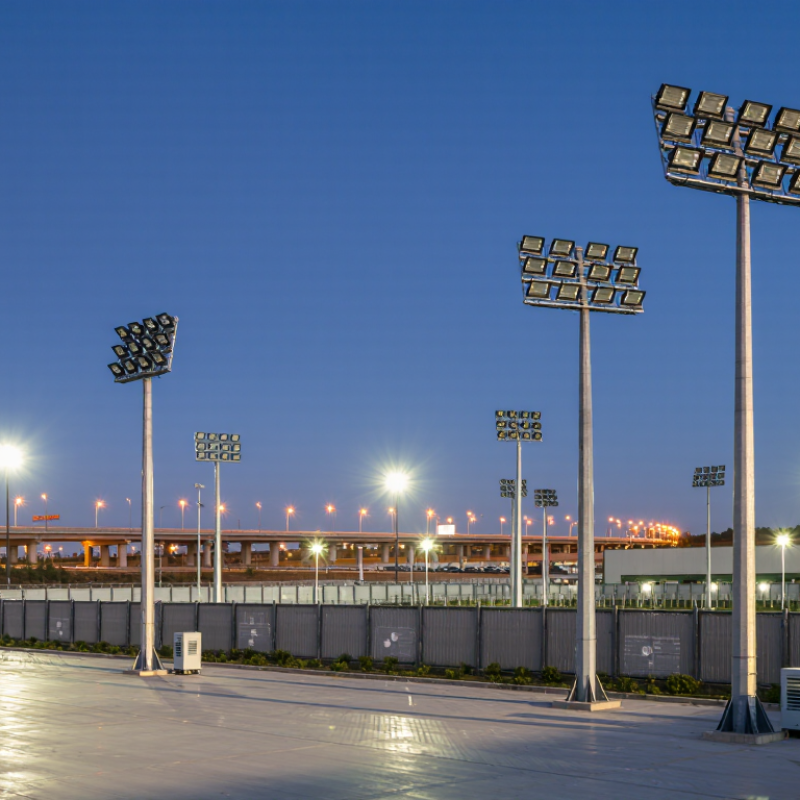
High mast lighting uses tall poles, often 20 to 40 meters high, to illuminate wide outdoor areas. Each pole carries several high-output LED luminaires near its crown. Unlike ordinary streetlights, these systems spread light across large, open surfaces. I have seen them used around container yards, airport aprons, highway interchanges, stadium approaches, and industrial storage grounds. The height reduces pole density and keeps vehicle movement clearer. It also makes maintenance planning more demanding.

A good installation begins with a photometric study, not a guess based on wattage. Engineers check mounting height, beam angles, glare limits, wind loading, and required lighting levels. In a busy logistics yard, a narrow beam can brighten loading lanes while limiting spill into nearby offices. Dimming controls may reduce energy use during quiet hours. Yet controls can fail when commissioning is rushed. That detail is easy to overlook.

High mast poles commonly use lowering systems, allowing technicians to service luminaires at ground level. This can improve safety and reduce equipment needs, but cables, winches, and locking parts need regular inspection. Coastal sites require careful corrosion protection, while dusty areas demand suitable ingress protection. LED life is long, but heat, voltage surges, and poor drivers can shorten it. Real performance depends on the whole system, not the fixture alone. Maybe site data should always decide.

China Top 10 High Mast Light Manufacturers to Buy From - What High Mast Lighting Is and Where It Is Used

No. High Mast Lighting Category Typical Mast Height Typical LED Power Recommended Application Key Technical Requirements Important Buying Criteria
1 Road and Expressway High Mast System 20–40 m 150–600 W per luminaire Expressways, interchanges, toll plazas, and large junctions IES-compliant road distribution, glare control, surge protection, and corrosion-resistant housing Photometric files, wind-load calculation, maintenance access, and roadway uniformity
2 Airport Apron High Mast System 25–45 m 300–1,000 W per luminaire Aircraft stands, cargo aprons, hangar surroundings, and service roads Low-glare optics, high color rendering, aviation-compatible controls, and reliable surge protection Uniform illumination, emergency operation, remote monitoring, and aviation authority requirements
3 Port and Container Yard Lighting 25–50 m 400–1,200 W per luminaire Container terminals, bulk ports, loading yards, and logistics areas IP66 or higher enclosure protection, marine-grade coating, high wind resistance, and narrow or asymmetric optics Salt-spray resistance, thermal management, anti-corrosion testing, and crane-operation visibility
4 Industrial Yard High Mast System 15–35 m 150–800 W per luminaire Factories, steel plants, warehouses, mines, and outdoor production areas Dust- and moisture-resistant construction, industrial-grade drivers, and stable thermal performance Operating temperature range, hazardous-area restrictions, maintenance intervals, and energy consumption
5 Sports Field High Mast Lighting 18–45 m 500–2,000 W per floodlight Football fields, athletics venues, tennis centers, and multipurpose stadiums Precisely aimed floodlights, low flicker, glare limitation, high color rendering, and instant controllability Horizontal and vertical illuminance, television requirements, spill-light limits, and aiming accuracy
6 Large Parking Area Lighting 15–30 m 100–500 W per luminaire Shopping centers, park-and-ride facilities, exhibition grounds, and transport hubs Wide-area distribution, pedestrian glare control, photocell or smart controls, and robust structural design Uniformity, lighting-class compliance, pole spacing, dimming capability, and total cost of ownership
7 Retractable High Mast Lighting System 15–40 m 150–1,000 W per luminaire Sites where lamps must be lowered for ground-level servicing Winch or lowering mechanism, locking devices, stainless or galvanized cables, and fail-safe operation Mechanical reliability, lowering speed, spare parts availability, inspection access, and safety certification
8 Fixed-Crown High Mast Lighting System 20–50 m 200–1,200 W per luminaire Open industrial, transportation, and municipal areas with limited servicing needs Rigid luminaire bracket, galvanized steel shaft, weatherproof junction box, and certified foundation design Access equipment, structural fatigue, wind speed, coating system, and planned maintenance method
9 Solar-Assisted High Mast Lighting 10–25 m 30–200 W per luminaire Remote roads, rural yards, emergency areas, and locations with limited grid access Photovoltaic sizing, battery autonomy, charge controller protection, and seasonal energy analysis Solar resource, required backup days, battery replacement plan, nighttime dimming, and theft protection
10 Smart-Controlled High Mast Lighting 15–45 m 100–1,000 W per luminaire Connected highways, airports, ports, campuses, and municipal infrastructure DALI, 0–10 V, or wireless control, remote fault reporting, programmable dimming, and surge protection Communication coverage, cybersecurity, interoperability, control-system ownership, and measurable energy savings
Reference note: The specifications above represent common market ranges for manufacturer-neutral high mast lighting projects. Final selection should be based on a photometric design, local wind conditions, structural calculations, applicable electrical codes, and the required lighting standard.

Key Criteria for Evaluating Chinese High Mast Light Manufacturers

When comparing China’s top ten high mast light manufacturers, evaluation should begin with evidence, not catalog images. Ask for recent project records, verified test reports, and clear production details. A reliable supplier should explain pole height, wind-load calculations, corrosion protection, and foundation requirements. Factory visits can reveal practical issues, including welding quality, coating thickness, and inventory control.

Review the lighting design carefully. Request photometric files, lux calculations, beam angles, and maintenance plans for the actual site. Check whether the proposed fixtures support suitable ingress protection, surge protection, thermal management, and stable driver performance. Independent laboratory reports add credibility, but verify their dates and testing scope. Certificates alone are not enough. Numbers matter.

Assess quality control throughout production. Ask how each LED module, driver, and cable connection is inspected before shipment. Confirm packaging methods for long poles and lifting equipment. Delivery experience also matters, especially when projects involve difficult ports or remote installation sites. Some suppliers provide impressive documents but vague answers about failures. That assumption can fail. A stronger manufacturer explains warranty limits, spare-part access, replacement procedures, and expected service life in writing.

Communication deserves equal attention. Technical staff should answer load, illumination, and installation questions without hiding behind sales language. Compare several quotations using identical specifications, not only unit prices. The cheapest offer may reduce coating thickness or omit essential accessories. I would also request references from projects with similar climate and pole height, then contact those operators directly. That step takes time, but it often exposes weaknesses before a purchase decision.

Top 10 High Mast Light Manufacturers in China

China’s top 10 high mast light manufacturers are attracting buyers through stronger LED performance, flexible production, and export experience.

High mast systems usually serve ports, highways, airports, stadiums, and large industrial yards. Their value depends on more than brightness. Buyers should examine photometric files, pole height, wind-load calculations, corrosion protection, and driver reliability.

The International Energy Agency reports that lighting represents about 15% of global electricity use. This makes efficient high mast lighting a practical energy-saving investment. The U.S. Department of Energy also identifies improved LED efficacy and controls as major drivers of solid-state lighting development.

In China, leading manufacturers commonly offer narrow-beam optics, remote monitoring, dimming schedules, and modular floodlight designs. However, published lumen figures can be optimistic. Ask for independent test reports based on LM-79, LM-80, or equivalent standards. A factory tour is useful, but it does not replace site testing.

Tips: Compare delivered lux, not only lumens. Request a real installation drawing. Check spare-driver availability for at least five years. Confirm IP66 protection and salt-spray results for coastal sites. One detail is often missed: maintenance access can cost more than the fixture. I have seen projects specify excellent lamps but ignore crane access, cable routing, and glare toward nearby roads. That is a design weakness worth admitting early. Supplier audits should also review production records, aging tests, quality control, and after-sales response times. A lower quotation may become expensive when replacement parts are slow or undocumented.

Comparing Products, Certifications, Customization, and Support

Choosing among China’s top 10 high mast light manufacturers requires more than comparing prices. Product performance should match the site, not just the catalog. Check pole heights, LED wattage, beam angles, wind-load calculations, and maintenance access. A 30-meter pole may suit a logistics yard, while a smaller installation may waste energy and increase glare.

Certifications deserve close review. Request certificates, test reports, photometric files, and protection ratings for the exact model offered. CE or ISO documents alone do not prove field performance. Look for corrosion-resistant galvanizing, stable drivers, IP66 protection, and documented thermal testing. I have found that clear drawings often reveal more than polished sales language. Brochures can overstate results.

Customization and support can separate a reliable supplier from an average one. Ask whether the manufacturer can adjust pole design, control systems, lighting distribution, foundation drawings, and packaging. Confirm spare-part availability, warranty conditions, installation guidance, and response times. Support matters after delivery.

Tips: Compare identical specifications in one table. Ask for a sample photometric plan. Verify references from similar projects. Discuss local wind and soil conditions early. Do not ignore small details. A delayed drawing or unclear warranty may become an expensive problem. Also, leave room for review: my first supplier shortlist was too focused on unit price, and that decision would have created avoidable maintenance risks.

How to Select and Purchase from the Right Manufacturer

Selecting a high mast light manufacturer requires more than comparing wattage and price. The IEA estimates that lighting consumes about 15% of global electricity, making efficiency a serious purchasing issue. Ask each supplier for verified lumen output, photometric files, LED lifetime data, and driver efficiency. A claimed 160 lm/W may describe the LED chip, not the complete fixture. Ask for proof.

Review the manufacturer’s engineering process. Check wind-load calculations, thermal testing, corrosion protection, surge resistance, and enclosure ratings. High mast fixtures face vibration, rain, dust, and difficult maintenance access. Request independent test reports and a sample unit before placing a large order. Test it outdoors. Compare the beam pattern on the actual pole height, not only in a showroom. The U.S. Department of Energy’s solid-state lighting research reports show that modern LED systems can exceed 150 lm/W, but real performance depends on optics, temperature, and power supply design.

Supplier reliability also matters. Examine factory quality records, production capacity, spare-part availability, and warranty conditions. Ask whether failures are repaired locally or returned overseas. Industry audits often find that unclear warranties create more cost than higher purchase prices. A spreadsheet can still mislead. Include installation labor, cleaning, energy use, replacement drivers, and downtime in the total-cost calculation. Do not guess. An honest manufacturer should explain limitations, not promise perfect performance in every climate.

China Top 10 High Mast Light Manufacturers to Buy From: How to Select the Right Manufacturer

Before comparing manufacturers, buyers should match the lighting system to the application, mounting height, optical distribution, maintenance requirements, and local compliance standards.

The chart shows common indicative mounting heights used in high-mast lighting projects. Actual specifications depend on photometric calculations, site dimensions, wind loading, illumination targets, and applicable electrical and structural standards.

Article Source: